Press
Week 3: Gas pricesWeek of 26 October
Read the transcript
Transcript of the segment as broadcast, with false starts and repeated words removed.
Ben Mulroney: Well, last week we introduced you to, I guess, a new public service is the best way to look at it, in the form of Benchmark Canada. And our friend Kevin Vuong is running this initiative where we want to create a common language of data points that we can look at when somebody makes a claim about something. It's not about owning anybody and it's not about dunking on anybody. It's about sharing a common language so that we can debate things in the same shared reality. And Benchmark has a weekly series going on over the next 10 weeks in the National Post where they take these very salient points and analyze them through the lens of unimpeachable data. And this week, it's "Your governments are to blame for high gas prices." Let's welcome back to the show Kevin Vuong. Kevin, welcome.
Kevin Vuong: Thank you for having me.
Ben Mulroney: Okay. So it was a political hot potato for years. The Liberals federally were denying that their taxes and their initiatives were leading to higher prices at the gas pump. But there was an immediate reaction when, with the stroke of a pen, our prime minister got rid of the consumer-facing carbon tax, and all of a sudden gas got cheaper. Gas got cheaper when we got a reprieve from the gas tax. So there are things that they can do. But how does the notion of "your governments are to blame for high gas prices" stack up against the data?
Kevin Vuong: So the data is interesting when you really break it all out. And I should say too, Ben, I don't write the headlines. I don't have control over that. Because what's interesting is when you break out the data and you look at, let's just say Ontario, for example, right? It's about, you know, a buck 80, plus or minus five cents, depending on the day, the time of day that you're filling up at the gas pump. About half of it is just the cost of the crude oil. Where the taxes come in is there's the embedded carbon policies, something called the Clean Fuel Regulation, which, you know, brass tacks, is really just carbon tax 2.0. There's the industrial carbon tax, but we don't pay that directly at the gas pump. That's further upstream. But then there's some fixed fuel tax. There's the excise tax, which the feds have temporarily put on hold for now during, you know, these high gas prices, provincial tax, and there's sales tax. This all nets out in Ontario to about 30 to 36 cents, because there's a bit of a range in terms of what people think the clean fuel regs cost. The Parliamentary Budget Officer says that's about seven cents. Dan McTeague, there's no one who I think knows more in this country about gas prices, and he estimates about 18 cents. But what's fascinating is, as much as that is, and let's be honest, that's a lot, if you put it in perspective of oil-producing democracies—
Ben Mulroney: That's a key word. That's where I was going to go next. Like, let's compare apples to apples.
Kevin Vuong: That's right. So, you know, we try to do exactly that. I'm not including the, you know, the dictators and all that sort of stuff, although we do have a tab if folks want to see how we compare. But if we look at just democracies, Canada is actually the third lowest. The lowest is the U.S., Brazil is the second lowest, and Canada is the third lowest in terms of the amount of tax that we pay at the gas pump. Norway is the highest. Half of what they pay at the pump is tax. Yeah, there is a lot of variation across the country, because where in Ontario it's about 30 to 36 cents, it's 62 cents in B.C., and especially in the Greater Vancouver area, where they have the special TransLink taxes, like an extra 18 cents. It's kind of crazy just how much.
Ben Mulroney: But hold on, let me throw a nuance at you, because the proposition is "your governments are to blame for high gas prices." It's not "your government taxes are to blame for high gas prices." So do you guys also consider decisions that have been made that make it harder for us as a nation to leverage the God-given natural resources that we have? Meaning, if we had more refineries, if we had more ability to take the crude and have it refined into gas that we can use in our cars, perhaps we would see a cheaper initial price.
Kevin Vuong: Yeah, and I'm glad you took it there. So you may remember, every week we have the news coverage of a benchmark indicator, and then the second piece is we have a domain expert. This week is Heather Exner-Pirot. She's the Macdonald-Laurier Institute expert and director of our energy resources development program. And she actually unpacks it. She talks through all this stuff: the industrial carbon tax, and also, you know, all of the different things that have limited production in this country beyond what it could be. And that has implications downstream for us as consumers, what we see when we fill up at the gas pump. And that's exactly where she goes, right? She talks about, you know, listen, the price of crude in the world is a global price. It doesn't matter if you're an oil-producing nation or not. Everyone starts from that same price. That being said, there's also refining capacity. We know that's been something that has been hampered in Canada for a long time. And that's all about contextualizing all of these things to help Canadians understand what these policy decisions mean. And this is not us as Benchmark Canada making these conclusions. We don't take a stance on that stuff, intentionally so, because I'm not here to advance a policy. I'm not here to take a position. I'm here to give you the data and let Canadians make the decision. I'm going to work with the National Post and others to bring in the experts who can talk through it, and then Canadians can consume it and decide for themselves.
Ben Mulroney: Yeah, listen, I don't think it is taking a position to say there has been a debate over the past 11, 12 years about whether or not we are looking at our oil and gas sector through the proper lens. And had different decisions been made, we may be in a different place that would then have led to either higher gas prices or lower gas prices. I think it's a counterfactual that is worthy of discussion. Again, I don't even have to take a position on it to know that that is something that's been explored. It's been debated, and we ended up where we are. And I'm sure I could come up with some counterfactuals that would have led us to an even worse position in terms of the cost of gas at the pump. But are there any other factors that you look at besides taxation as well as government policy towards the oil patch?
Kevin Vuong: So this particular indicator is one of the ones that falls under our Elevate pillar, which is our "are Canadians flourishing?" And the position being that, you know, if our people are thriving, we're probably going to be paying less for things. And ultimately, that's why we decided to hone in on this. There are other indicators under the Elevate pillar, one of which is, you know, how strong is our dollar? And it's related to gas prices, because anyone who reads the coverage today will hear from Dan McTeague's own analysis, which is, traditionally, Canada has been a petrodollar, being that if there's some sort of oil shortage or crisis, our dollar typically appreciates. But in the last 10 years, that relationship has completely decoupled. And so right now, with the Strait of Hormuz and all those things, you'd think our dollar would be up. It's actually down. And that is an impact on Canadians. And that ultimately means we can buy less. Things are much more expensive as a result. And so there actually is a relationship between gas prices, our oil production, and how strong our dollar is, and obviously then what that means for Canadians.
Ben Mulroney: Well, it's fascinating. Again, I'm so glad you guys are doing this, if only for us to be able to find common cause in the data, in the numbers, so that we can have differing opinions, but they're all based in the same reality. We're playing on the same field. We're playing the same game. And you guys are doing yeoman's work there. Next week's article is, what's the next one you're looking at?
Kevin Vuong: So next week, well, next week it's budget week. So we're going to be looking at some budget and finance-related metrics, some of which are actually going to be consumer loan arrears. So, you know, that sounds boring, but how many people are behind on their car payments? How many people are behind on various, you know, household debt aspects, right? And you hear a lot about just how Canada has some of the highest, I think the highest, household debt in the world. You know, what does that mean? And what is the trend in velocity? And we're going to unpack that further with experts.
Ben Mulroney: Well, if people want to read Benchmark each week, they can go to the National Post or they can go to benchmark.org. Kevin Vuong, thank you very much, my friend.
Kevin Vuong: Thank you. Talk to you next week.
Week 2: Mortgage delinquenciesWeek of 19 October
Read the transcript
Transcript of the Benchmark Canada portion of the segment as broadcast, with false starts and repeated words removed.
Ben Mulroney: All right, so off the top of the show, I was talking to you about how we have so much information, but no ability to critically look at it and apply it universally. Half the country doesn't even believe the numbers anymore. And you'd be hard pressed not to understand why, when we have politicians touting how great something is, only for the people experiencing it to say, no, it's not that. And I'm deliberately being vague because I don't want to make this about one party, because everybody is guilty of it. But that doesn't mean we can't bring solutions to bear. So I'm so glad to have this guy back on. I love all of our conversations. Kevin Vuong, former member of Parliament for Spadina–Fort York, senior fellow at the Macdonald-Laurier Institute, and now director of Benchmark Canada. Welcome, my friend.
Kevin Vuong: Thanks for having me on, my friend.
Ben Mulroney: What is Benchmark Canada?
Kevin Vuong: Benchmark Canada takes what everyone does in business, which is benchmarking, seeing how you do relative to your competitors. Because, Ben, if you grow by 15%, that sounds great. But if all your competitors grew by 25%, it doesn't matter how you try to sell it in the press release, it's still not as good as everyone else. And so we take a very common business practice and we apply it to the country with transparent sources, right? Disinformation, misinformation, it's a huge problem. What's the best disinfectant? Sunlight. And so we transparently show what our sources of data are. We clearly articulate what the methodologies are. And then we put the numbers in context so we know how Canada is ranking relative to our peers. Most of the time it's the G7. But, you know, for stuff like defence, it makes sense for us to compare to NATO. And if for some reason we can't find an international peer set, we will then, for example, one of our benchmarks is CRA wait times, measure it based on Canada's own service standards and whether or not we meet it, which unfortunately we don't in the CRA's case.
Ben Mulroney: And look, I want to trust the numbers. I want to get to a point where I trust the numbers that I hear from our politicians, right? So when my prime minister, and I've got to mention him because he's the prime minister now, when my prime minister says we have the fastest growing economy in the G7, I want that to be true. I know it's not. And I don't like that my default setting isn't to trust. And the same thing goes for, oh, I want to believe that we are up to 2% of our GDP on military spending, you know, moving up to 5% eventually. But I heard somebody say, and I've never talked about it on the show because I never took the time to validate it, I didn't want to throw cold water on what I think is a really noble pursuit by the prime minister, but somebody said that a lot of the money that is earmarked to get us to this 2% is not necessarily going to the places that will bring us to the end result that we all want. And so I want to believe the numbers, and hopefully Benchmark is a first step in kind of forcing the hands of people who massage the numbers to make them mean what they want.
Kevin Vuong: Yeah, absolutely. Let's continue on your defence example, right? So it's true. We're finally hitting the 2% threshold, and that's fantastic. But that's also just one measurement of money in. What are we getting for our hard-earned tax dollars? Well, equipment spending, which, by the way, there's a NATO guideline: 20% of the money being spent should be going towards that. And how does that rank for Canada? Now, the good news is we're finally also meeting that 20% threshold. But if you put where Canada is relative to our allies, we actually rank 28th of 31, right?
Ben Mulroney: Yeah, because correct me if I'm wrong, a lot of the money that's being spent right now, it's being spent on important things, but it's because our military fell into such disrepair that we have to repave roads, and we've got to rebuild the infirmary on a base, right? So stuff that you just assumed would have been done, basic upkeep, no, that's where some of this money is going right now.
Kevin Vuong: Yeah, and, you know, listen, if shining more light actually forces further accountability, that is, for me, one of the missions that we've accomplished. It's also elevating discourse, right? So we're cutting through the slogans and the BS that you and I hate. And I want to be clear, this isn't a partisan endeavour. I'm not looking to tell you the country is broken. I'm not looking to advance particular interests or even a policy agenda. We specifically stay away from it so that we can just give data for people to make their own conclusions. And yes, we do have verdicts. Is it weak? Is it watch? Is it strong? And the simple methodology is: does Canada rank in the bottom third, middle third, or top third in the peer set?
Ben Mulroney: And so this is going to be in the National Post, like a 10-week run, correct?
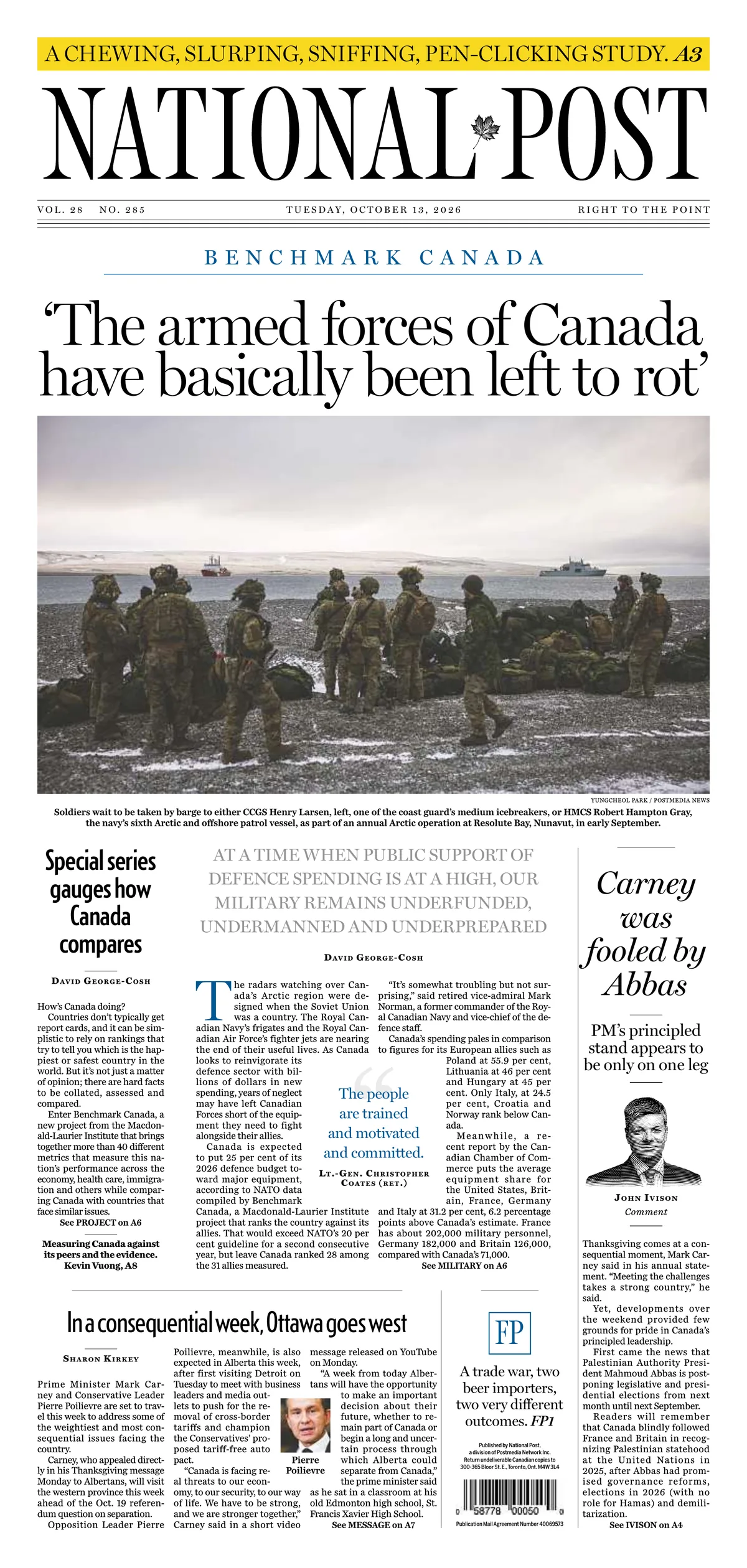
Kevin Vuong: That's right. So every Tuesday you're going to see it in the National Post. We launched the day after Thanksgiving, on the 13th. And what's also going to be happening is we are engaging domain experts. So when we launched with defence on the 13th, I engaged former Lieutenant-General Christopher Coates, a three-star general who was commander of Canadian Joint Operations Command and deputy commander of NORAD, as well as Vice-Admiral Mark Norman, who was vice chief of the defence staff, to unpack it further, right? Again, the whole point is to give Canadians unfiltered, nonpartisan, actual facts, and then bring in experts without, you know, the political rhetoric, so they can get some real understanding around where the country is and how we're actually doing relative to our peers.
Ben Mulroney: And like I said, hopefully this will create a guardrail against taking objective numbers and putting them through a subjectivity filter, and it'll prevent politicians of any stripe from taking a number, you know, like the GDP numbers, the annualized quarter numbers of 3.3%, and extrapolating it over a year and saying fastest growing economy. If our politicians know that Benchmark is watching, and if people start paying attention to Benchmark, then they are going to have to err on the side of Benchmark.
Kevin Vuong: Yeah. I mean, you know, you would have heard since 2025 now, Canada has the best debt-to-GDP ratio in the G7. And that is true if you use the net debt calculation, which, to be fair, one of the four largest credit agencies in the world uses. But if you use what everyone else does, including the OECD, you would actually be using gross debt, where, by the way, Canada is still third in the G7. We're not the best, but it's a very different number with a different methodology. Now, it's not up to me to decide which one is best, but what we're doing is we're showing that, hey, there are different measurements and accounting that you can do, and who uses what, and now it's up to Canadians with that knowledge to decide what's most appropriate.
Ben Mulroney: You know, I always like to point out, a number is only valuable if you've got context for it. If you have a podcast that has one subscriber, and then a year later you've got 100, well, the popularity of your podcast has exploded. It's the fastest growing podcast in the world, and you should be proud of that. We should get sponsors with that. So without the context, the number and the spin on the number is meaningless. And so I do appreciate this. But what happens after the run in the National Post is done? I mean, you're the director of Benchmark Canada. I don't think this is a 10-week tenured position.
Kevin Vuong: No, not at all. It's our intention to not only continue to do this, because, you know, data gets refreshed, right? But also to work with other domain experts. We arrived at the original 44 indicators engaging with experts in different aspects of the country, but also globally. And I should share, too—
Ben Mulroney: Actually, you know what? Hold on to that, because if it's all right, I want to keep you for a little bit, my friend. There's a lot of meat on this bone. […] You are listening to the Ben Mulroney Show, and Kevin Vuong has stuck around, and I appreciate it. He's working on a great new project, Benchmark Canada. You know, back in the day, Kevin, we all had the same facts, and from those facts we informed our positions, our perspectives, our visions. And now everyone seems to have their own set of facts, and I say that with air quotes. But it occurred to me during the break that all it's really going to take for Benchmark to become the thing that I think we probably need in this country, as we set out to build and in certain cases completely rebuild parts of this country, is for someone of influence in Ottawa to quote Benchmark. You know, if the government says, according to Benchmark Canada, we have done X, Y, or Z. Because once they do that, they're tethered to you, right? If they've used you once, they have to be willing to live and die by the Benchmark sword.
Kevin Vuong: Yeah, and actually one of the places where this was born was speaking to a former deputy minister, which, for those who don't know, a deputy minister of a federal department is like the all-powerful being. DMs largely stick around and they have immense control and authority, but they don't know what they don't know. And so part of this is also equipping our public servants with the data to help them make better decisions. Because the reality is, and again, this applies to any government of any political stripe, people are very hesitant to put forward specific KPIs, key performance indicators, because if you don't meet them, that's red meat for the opposition to tear into you. But we need those to know how we're performing. And everyone else does it. Government should do it as well, right? We have 44 indicators that we've developed, and I should say for your listeners, they're structured along five pillars. The first is: can we finance this country? Second is: can we still build in this country? Third is called govern: can we deliver government services? The fourth is secure: is it safe, can we protect our people? And the test that we run all these four against is the fifth, which is what we call elevating. Are our people prospering? Because a serious, mature country that is performing is uplifting the prosperity of its people. And so all of our indicators are along these five pillars.
Ben Mulroney: And I love it. As I've said, and I think I'm going to say it every day, I didn't vote for Carney, but I'm rooting for him. Because if he achieves the things he says he's going to achieve, then we all win. But I don't want to give him a ticker tape parade if the numbers that are being cited for the victory lap are based on vapour. And so I'm glad that you guys are watching the watchers. What are the long-term goals for Benchmark Canada? Where do you want to see this in a few years?
Kevin Vuong: So we definitely want to continue to grow indicators. We welcome people to suggest them, and there's a robust process for us to do that. But I want to take it in two ways. I can tell you in the medium term, we're building a tool that allows people to slot in whatever indicators they want along a time series and do their own analysis, right? And see, for example, our currency strength: the Canadian dollar has gotten quite weak over the last decade plus, right? Is there a relationship with oil production in this country? Because we do know there's been a decoupling of the relationship of our dollar with oil. Traditionally we're a petrodollar, right? So if there's an oil shock, our dollar goes up in value. But in the last 10 years, that relationship has decoupled. So, oil shock, our dollar isn't appreciating as it used to. And so that's a tool for people to play around with and see if there are other relationships. The one after that is a country profile. Because there are very successful countries out there, Singapore, where we map out all these different indicators and work backwards in terms of, okay, if Singapore is something we want to work towards, what are the different aspects of how they're built as a country? What is the size of their public service? Canada's grew by over 43% over the last 10 years. That was out of whack with the rest of the G7. The second highest growth was basically half of that, from the UK. What is Singapore's, if they are a country we want to work towards, right? But the converse example is France. A lot of people point to France as a socialist haven, and parts of it are beautiful, but it's not very beautiful right now. And there are decisions that France has made, right? You fund some things, you don't fund other things, and we're seeing that chaos play out now on the streets of Paris and across Europe. You know, what is the country profile for France, and how does that map to Canada?
Ben Mulroney: It's shocking to me how much of the public finances in France are dedicated to social spending. And with the results that we saw last week, you're telling me you spend over 50% of your budget on health care and social spending, and you've got riots. You had a month-long protest on inequity in schools, which then got co-opted and turned into something else. They just keep digging a hole there. But no, I'm really looking forward. Thank you so much for working on this, because it's important.
Read the transcript
Transcript of the Benchmark Canada portion of the segment as broadcast, with false starts and repeated words removed.
Jon “Gonzo” Mark: Kevin Vuong, a former Toronto-area member of Parliament, joins us at this time on Mondays. And I see you've launched a little project in the National Post to nurture data-based debate here in Canada, for some plain facts and plain talk. Tell us why you got started in that, Kevin, and what the end game is.
Kevin Vuong: Thanks, Jon. Listen, the end game is about cutting through the BS and the politics, and actually getting to doing the work of building a better country. This exercise that we do of benchmarking is really common in business, right? If you grow by 12%, which sounds great, but all your competitors grew by 25%, you didn't actually do a good job, no matter how the press release is going to try to spin it. And that's fundamentally what this is all about. We developed 44 metrics that look at the country from five different aspects. Can we still finance this country? Can we still build in this country? Can we govern? Can the government deliver services? Can we secure and protect this country and its people? If all of these four pillars are being done well, the test that we run them up against is: are we ultimately elevating our people, and are our people flourishing and thriving? And so it's all about putting all of this country's different aspects into context. So how does Canada perform, for the most part, against our G7 counterparts, or, in cases like defence, how does Canada rank relative to our NATO allies, right? So we launched, thank you for bringing it up, last week on the front page of the National Post across the country. And we focused on defence that week. And so for the first time, Canada's finally meeting 2% defence spending on GDP. But if you put that in perspective, we're actually, I think, fourth or fifth from the bottom in terms of how we rank in the alliance. If you look at what return on investment Canadians are getting for our hard-earned tax dollars, in terms of actual defence investments in procuring equipment, similar kind of results, right? I think we're 28th of 31. So it's great that we're finally meeting these commitments in terms of the spending, but what are we actually getting, and how do we rank? There's still a lot of improvement that needs to be done. And that's what this is about: getting the facts, so we can stop trying to establish where we are, which ends up being a political bun fight and is a waste of everyone's time, and get to where the facts are, so we can have constructive conversations about building up this country.
Week 1: Launch and defence spendingWeek of 12 October
Read the transcript
Transcript of the segment as broadcast, with false starts and repeated words removed.
Elias Makos: Welcome back to the Elias Makos Show. Now, when we look at our country's economic and social progress, Canadians are constantly told that we are doing well, we're moving forward, we're holding our own on the global stage. Ladies and gentlemen, you listen to the station, how often do you get an ad from the government of Canada paid for by your tax dollars saying, hey, we're building Canada strong, things are amazing right now. Now, some business and policy experts are pointing out that, yeah, we've got some growth. It's incremental, though. And if you compare us to our international competitors, our peer countries in the G7, some of those countries are accelerating much faster than we are. Now, a new data-driven benchmarking resource is cutting through the political spin to measure how Canada actually stacks up against its peer nations across critical economic and domestic metrics. So let's find out where we truly are excelling, where we are falling behind. With Kevin Vuong, former MP for Spadina–Fort York, and now the head of the Benchmark Canada Project. Kevin, welcome back to the program.
Kevin Vuong: Elias, thanks for having me.
Elias Makos: Why'd you start this? Why'd you start Benchmark Canada?
Kevin Vuong: Well, you know, you talked through it really well, right? When I was an entrepreneur, we used benchmarking all the time. It's a common business tool. If you grow by 15%, that sounds great. But if all of your competitors grew by 25%, you actually didn't do well, no matter how the press release may try to spin it. Right. And so that was where I was starting. The second was during my time in Parliament, I saw that a lot of my colleagues, you know, when they were assigned to a committee, it didn't necessarily mean that their expertise tracked that committee. And so, you know, you're sitting on a health committee, you may not be coming from a health background. You're sitting on an industry committee, same thing. And so what would people do? Well, you know, they would either go to the department's own resources, and obviously they're going to have a particular bias to present information a particular way. They can go to the government's press releases. Again, there's going to be an incentive to present things a certain way. Or they can go to their own party's caucus research team. Again, everyone has an incentive to frame things in the best way that makes them look the most positive. That's not what we need. What we need are facts so we can cut through the political rhetoric. And so those two things together led us over the last year now to develop these benchmarks, to ultimately measure how Canada is doing relative to our peers. A lot of times, Elias, that was the G7. Sometimes, like, say, on defence, it made sense to look at it from a NATO perspective, right? And everything here on our website, benchmarkcanada.org, is transparently sourced. Its methodology is transparently shared. And it's all about elevating the discourse so we can get to the facts and start working on the things that we need to do to make the country better, as opposed to getting stuck in the slogans and the politics of it.
Elias Makos: Why don't you give us some examples here of what you're tracking, maybe some unique categories we don't often think about here, and let our listeners know the good, the bad, and the ugly when it comes down to how Canada is doing.
Kevin Vuong: Sure. So we launched this week with defence. And so if you look at defence, and I'm going to narrow it beyond just spending, right? Spending is just the input. What matters is what we get for our hard-earned tax dollars. And so NATO actually tracks this across the entire alliance. One of the measurements, the output, is equipment spending. You know, there, if you look at how much of our money is going towards acquiring equipment, yes, we clear NATO's 20% guideline. That's great. 25% of our defence budget goes to equipment. Awesome, right? If you stop there. But if you look at us relative to the rest of NATO, Canada lists as 28th of 31. Right. You don't hear that. You're not going to hear that.
Elias Makos: 28 of 31.
Kevin Vuong: Yeah. So we're the fourth worst in the alliance. You're not going to hear that from the department. You're not going to hear that from the government. And so while we absolutely are improving, and yes, we're hitting the threshold, that doesn't mean that we're necessarily doing well. Another example that I want to provide is one that your listeners will have heard, but where you don't really go beyond the surface level, which is you'll hear the government talk about our debt to GDP. We're the best in the G7. And that is true if you use our net debt measurement, which is what only one of the four largest rating agencies in the world use. Everyone else uses gross debt. And if you use gross debt, we're actually only third. We're middle of the pack. And the measurement actually goes very different, right? We go to 110.7% of GDP as opposed to, I think it's just a little bit over 10%. So there's a huge difference in how you measure. And so I don't blame the government. You know, if they want to run with net debt, sure. Does the largest rating agency use it? Yes. But everyone else uses gross debt, and in fact, the OECD and other large global institutions use gross debt. And so again, this isn't about me criticizing the government. This isn't a partisan endeavour. It's about putting the information out there so Canadians can see what the facts are and get it with context in terms of our peers, but also context in terms of how things are actually measured and compared.
Elias Makos: But Kevin, let me just say, you know, the website, benchmarkcanada.org, it's a good-looking website. You're using a lot of common-sense things like colour coding and words to describe, like, red is weak and orange is watch and green means, okay, it's good. Obviously, what green means there. And I'm looking at the board here. And boy, am I seeing a lot of red and a lot of orange. Okay. A lot of red, a lot of red, weak, on the categories of building and governing and securing and elevating here. So I look at that, but again, that's just my initial assessment here where I go, ooh, things are not good. But is that, I don't know, is that an accurate assessment? Just looking at what stares at me on this front page.
Kevin Vuong: So first, let me say, the verdicts that came out, whether it is strong, watch, or weak, are actually very straightforward. It's, are we in the top third of the countries that we're being compared against? If so, then we're strong. If we're in the middle third, it's a watch. And if we're in the bottom third, it's weak. And, you know, so that's kind of the weighting. And ultimately, then it's just an average across the five pillars. And you're right. There is a lot of it that is coming across as watch or weak. I guess we should probably say, Elias, there's five pillars that the 44 benchmarks are sorted into. The first is finance. Can we afford to build? The second is build. Can we actually build in this country? Third being govern, right? What is the government delivering, and are they delivering it well or not? Secure: can we defend ourselves? And the final is what the first four is kind of the test that we run, which is if a nation is doing these things well, our people should be thriving. And are we elevating our people? And so unfortunately, based on our indicators, a lot of it does end up with a verdict of watch or, you're right, weak. I will say there are some that came out green, or strong, that I was surprised about.
Elias Makos: Right. Tell me about those. Give me some positive here. What surprised you?
Kevin Vuong: So what surprised me was mortgage delinquencies. You hear a lot about how people are living paycheque to paycheque, right? How people are having a really hard time making ends meet. And I definitely heard that during my four years as a member of Parliament for the Toronto area. But when I look at our mortgage delinquencies, which is how many people have missed mortgage payments that are over 90 days in arrears, right? So that's three months of payments missed. We are actually doing very well. We're actually the second best in the G7. Only Japan is lower than us. So that was really good news. What I will say, that came out as part of this exercise looking at mortgage delinquencies, though, is we also have the fastest-rising arrears rate in the G7. So over the last four years now, the arrears rate, so people who have missed 90 days' worth of payments, has actually doubled.
Elias Makos: We were so low to begin with.
Kevin Vuong: Right.
Elias Makos: That we're still low, but the rate is accelerating. Kevin, I'm going to direct all of our listeners to go check out the website. Again, it's benchmarkcanada.org. Really nicely done. Colour-coded. All of the different metrics on just how Canada is doing. I think it's eye-opening. Thank you so much for sharing this morning.
Kevin Vuong: Thanks for having me.
Elias Makos: Kevin Vuong is former MP for Spadina–Fort York, and he's now the head of the Benchmark Canada Project.
Launched on the front page of the National Post